

Plate bending machines
Hydraulic Four Roller Plate Roll bender
Two Roller Steel Bending Machine
Three Roller Bending Machine
Four Roller Rolling Machine
Profile bending machine
Auxiliary products
Upper Roll Bending Machines
Industry News
Structure and Working Principle of Four-Roll Plate Rolling Machine
A plate rolling machine is a forming device that bends metal or non-metal sheets into cylindrical, conical, spherical, or other curved shapes.
Among various machine types, the four-roll plate rolling machine stands out in large-scale metal forming applications due to its high efficiency, precision, and versatility.
As a widely used metalworking machine, the four-roll plate rolling machine shapes metal plates—such as steel and aluminum—into required forms and dimensions through coordinated rolling action.
After a single feeding operation, the machine can complete pre-bending and rolling of cylindrical and arc-shaped workpieces.
Moreover, with auxiliary devices, it can also roll conical shells efficiently.
In a hydraulic four-roll plate rolling machine, the upper roll serves as the main drive roll.
The gearbox output gear meshes with the upper roll gear to deliver rolling torque to the plate.
Meanwhile, the lower roll moves vertically under hydraulic cylinder force, allowing it to clamp the plate securely and provide stable hydraulic transmission.
On both sides of the lower roll, the side rolls tilt along the machine frame guide rails.
A screw-and-nut mechanism combined with a worm gear drive controls this inclined movement precisely.
The machine adopts a hydraulic drive system, which delivers high positioning accuracy and stable operation.
All rolls move synchronously, ensuring uniform deformation along the full plate length and producing smooth, consistent rolling results.
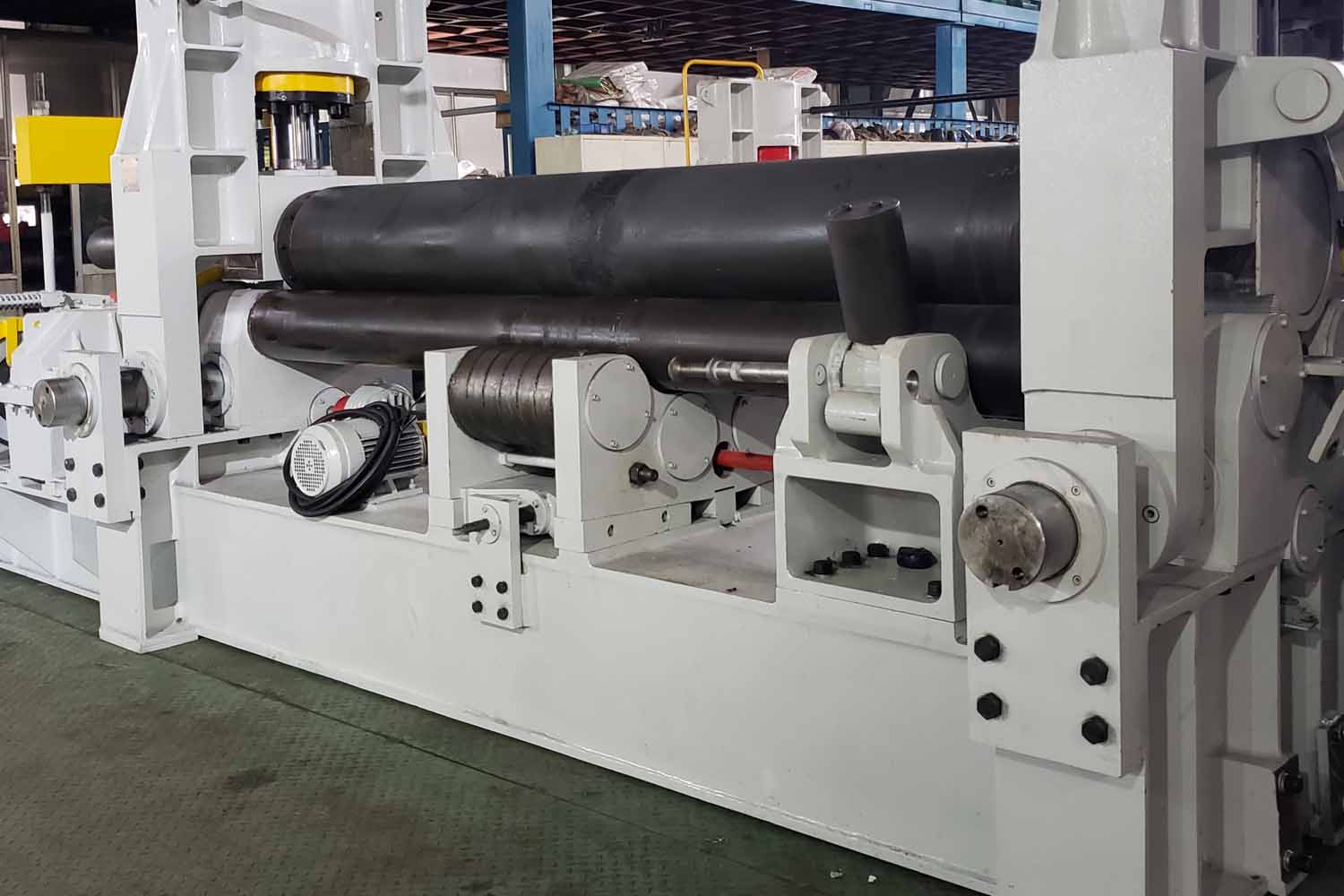
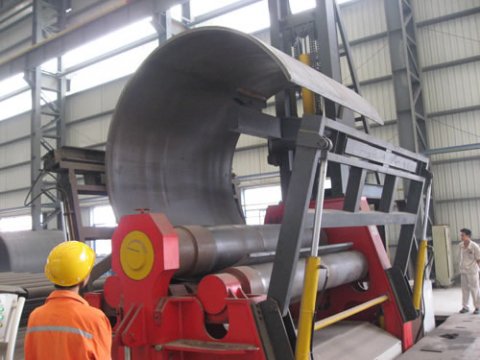
Structure and Working Principle of the Four-Roll Plate Rolling Machine
Structure
- The four-roll plate rolling machine consists of four main rolls: one upper roll, one lower roll, and two side rolls.
- The upper roll acts as the primary driving component.
- It connects to the main motor through a reducer and coupling, generating the torque required for smooth plate rolling while applying downward pressure to the metal sheet.
- The side rolls operate in coordination with the upper roll, maintaining balance and stability during the rolling process.
- At the same time, hydraulic pressure drives the lower roll to move vertically.
- Hydraulic oil pushes the piston upward inside the cylinder, allowing the lower roll to clamp the plate firmly and prevent slippage during bending.
Working Principle
The four-roll plate rolling machine relies on the rotation of the upper and lower rolls, combined with the coordinated action of the side rolls, to gradually bend the metal plate into the desired cylindrical or curved shape.
- During operation, hydraulic or mechanical systems drive the upper and lower rolls to rotate.
- Friction between the rolls and the plate pulls the metal sheet forward.
- Meanwhile, the side rolls move up and down under hydraulic or mechanical control, applying lateral pressure to the plate.
- This pressure forces the plate to bend progressively and conform to the curved surfaces of the upper and lower rolls until it reaches the required shape.
- In addition, support rolls provide auxiliary support, effectively preventing deformation, wrinkling, or creasing during rolling.
- As a result, the machine achieves high-quality and consistent forming results.
- Operators can flexibly adjust the position and speed of all four rolls according to specific processing requirements.
- Therefore, the machine can precisely roll plates of different thicknesses, widths, and curvature radii.
Conclusion
In summary, the four-roll plate rolling machine is a versatile forming solution for metal bending applications across multiple industries.
By allowing all rolls to work in coordinated sequence, the machine applies uniform force across the plate, ensuring even bending and accurate curvature.
By combining hydraulic precision with mechanical efficiency, the four-roll design delivers uniform bending, high productivity, and excellent surface accuracy across the entire plate.
Consequently, the four-roll plate rolling machine has become an essential piece of equipment in industries such as shipbuilding, pressure vessel manufacturing, and steel structure fabrication.


