

Two Roller Steel Bending Machine
Three Roller Bending Machine
Four Roller Rolling Machine
Profile bending machine
Auxiliary products
Upper Roll Bending Machines
Industry News
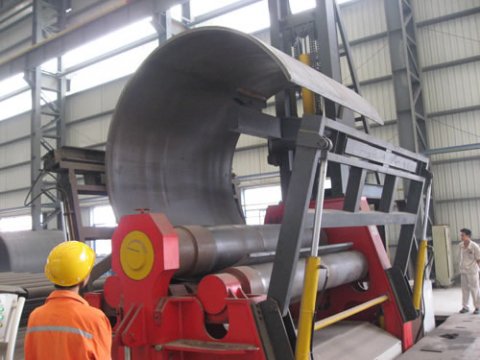
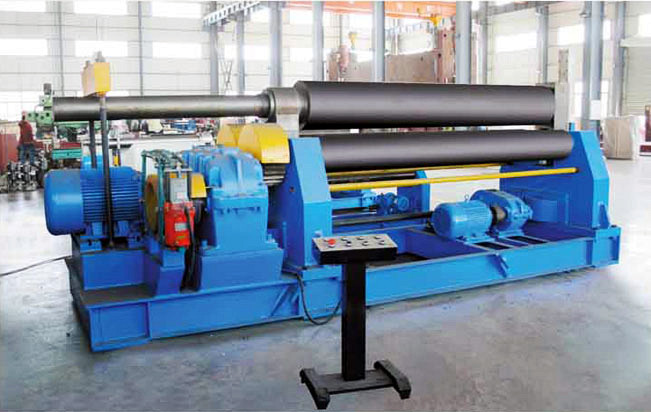
A Plate rolling machines (also known as a plate bending machine or sheet metal roller) is general-purpose forming equipment that rolls metal sheets into cylindrical, arc-shaped, or other shaped workpieces. Operating on the principle thatthree points define a circle, it uses the relative positional change and rotational motion of the workpiece to induce continuous plastic deformation of the plate, thereby producing a workpiece of a predetermined shape.
Plate rolling machines are widely used in the manufacture of boilers, shipbuilding, petroleum equipment, woodworking machinery, metal structures, and other mechanical manufacturing industries. In these sectors, rolled plates are frequently transferred, staged, and fed into downstream processes — a material-handling task for whichvibrating conveyorsare often employed as a reliable, enclosed, and low-maintenance solution.
Understanding Vibrating Conveyors
A vibrating conveyor is a bulk-material handling system that uses directional vibration — generated by vibrating motors or exciters — to make particles saltate or slide along a trough. Because there is no return strand (unlike a belt) and no heat-degrading belt surface, vibrating conveyors are well suited to hot, abrasive, or granular materials and can be configured for horizontal or inclined transport.
In metal-structure and plate-fabrication plants, Mining conveyors are commonly used to move cut plate scrap, slag, finished small parts, or hot by-products between workstations. Their simple, robust construction, ease of sealing for dust control, and low maintenance requirements make them a natural complement to heavy forming equipment such as plate rolling machines.
Why Bearing Temperature Matters
When a plate rolling machine is running, the temperature of the bearings and other moving parts will rise as a result of equipment operation. A certain amount of temperature change is normal and permitted during operation. However, operators should remain alert to any instance ofexcessive bearing temperature, as it is often an early warning sign of underlying mechanical issues that, if ignored, can lead to premature bearing failure and unplanned downtime.
Causes of Excessive Bearing Temperature
Excessive bearing temperature in a plate rolling machine is typically the result of one or more of the following conditions:
1. Poor Lubrication
- Insufficient lubricationor, conversely,over-lubrication.
- The quality of the lubricating oil does not meet requirements, or the oil hasdeterioratedor becomecontaminated with debris.
2. Insufficient Cooling
- Cooling pipelineblockage.
- Improper cooler selection leading to apoor cooling effect.
3. Bearing Abnormality
- Excessive loadon the plate rolling machine bearing.
- Bearing damageor a pre-existing defect.
- Poor bearing assembly process, orover-tight assembly.
- The clearance adjustment of various parts within the bearing housing does not meet specification requirements.
4. Excessive Vibration
- Poor or non-compliantcoupling alignmentprocess.
- The rotor hasdynamic and/or static imbalance.
- Poor foundation rigidity, such asweak or unstable footing.
- Rotational stall andsurgephenomena.
5. Insufficient Clearance
- If the assembly clearance of the plate rolling machine mechanism is insufficient, thebearing cage and rolling elements may fracture, which in turn causes the bearing temperature to rise excessively.
Conclusion
For newly installed or re-adjusted bearings, the bearing temperature rise of the Plate rolling machines should be monitored by temperature measurement over a defined period of time. This allows operators to verify and judge whether the bearing installation and adjustment have been carried out correctly.
Coupled with proper lubrication, cooling, alignment, and clearance control, such monitoring helps ensure reliable, long-term operation of the plate rolling machine within the broader production line — including the vibrating conveyors and other material-handling equipment that support it.


