

Two Roller Steel Bending Machine
Three Roller Bending Machine
Four Roller Rolling Machine
Profile bending machine
Auxiliary products
Upper Roll Bending Machines
Industry News
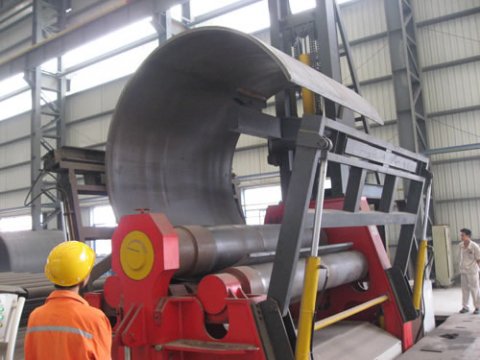
A4-roll plate rolling machineis an essential piece of equipment for bending and forming metal plates. It uses four working rolls to gradually bend flat metal sheets into cylindrical, conical, or other curved shapes.
Compared with traditional 3-roll plate rolling machines, a 4-roll design provides better control over plate positioning and bending. The operator can use the upper, lower, and side rolls to hold and guide the plate during the rolling process. This setup helps improve forming accuracy, reduce plate slipping, and simplify the overall operation.
A typical 4-roll plate rolling machine consists of:
- Upper and lower rolls
- Side rolls
- Machine frame
- Hydraulic or mechanical drive system
- Roll adjustment system
- Control system
During operation, the operator positions the plate between the rolls and adjusts the roll positions according to the required bending radius. The rolls then rotate and gradually form the plate into the desired shape.
How Does a 4-Roll Plate Rolling Machine Work?
A 4-roll plate rolling machine controls the position and movement of four rolls to complete the bending process.
First, the operator places the metal plate between the upper and lower rolls. The lower roll supports the plate, while the side rolls help control its position and bending angle.
Next, the operator adjusts the side rolls according to the required bending radius. As the rolls rotate, they feed the plate through the machine and gradually form it.
This four-roll configuration provides accurate plate positioning and makes pre-bending easier. As a result, the machine can reduce the remaining straight edge and improve the quality of the finished cylinder.
For CNC or hydraulic models, the control system can also coordinate roll movement and rotation, helping operators achieve consistent results during repeated production.
Applications of 4-Roll Plate Rolling Machines
4-roll plate rolling machines serve a wide range of metal fabrication applications. Manufacturers use them to produce cylindrical shells, pipes, tanks, cones, and other curved components.
Common applications include:
- Pressure vessels and storage tanks
- Industrial pipes and pipelines
- Boilers and heat exchangers
- Wind tower sections
- Shipbuilding components
- Oil and gas equipment
- Petrochemical equipment
- Steel structures
- Mining equipment
- General metal fabrication
Because different industries require different plate sizes, materials, and bending radii, manufacturers can configure the machine according to specific production requirements.
Vibrating Conveyor for Metal Fabrication Lines
In addition to plate forming equipment, many metal fabrication and industrial production lines require reliable material handling equipment to move materials between different processing stages. A mining Conveyor uses controlled vibration to transport bulk, granular, or small-piece materials continuously and evenly.
The conveyor typically consists of a conveying trough, vibration drive, springs or elastic supports, and a supporting frame. When the vibration system starts, the trough moves in a controlled direction and transfers material from the feeding point to the discharge point.
Depending on the production process, a vibrating conveyor can transport materials such as metal scraps, steel parts, castings, pellets, powders, and other industrial materials. It can also connect different machines and help maintain a continuous material flow throughout the production line.
Key advantages of a Vibrating Conveyor in clude:
- Continuous and stable material conveying
- Simple and compact construction
- Suitable for various bulk materials
- Easy integration into automated production lines
- Reliable operation in demanding industrial environments
- Flexible conveying capacity and layout options
For metalworking plants, the vibrating conveyor can work alongside plate rolling machines, cutting machines, crushers, feeders, and other processing equipment. By improving material transfer between different stages, it helps create a more efficient and continuous production workflow.
Advantages of a 4-Roll Plate Rolling Machine
A 4-roll plate rolling machine offers several practical advantages for modern metal fabrication.
1. Accurate Plate Positioning
The four-roll structure helps hold the plate securely during the bending process. Operators can adjust the rolls from different directions to achieve more accurate positioning.
2. Easy Pre-Bending
The machine can perform pre-bending before the main rolling operation. This feature helps reduce the straight edge at both ends of the plate and improves the final shape.
3. Higher Production Efficiency
The machine requires fewer manual repositioning steps than many conventional rolling processes. Therefore, operators can complete repeated bending operations more efficiently.
4. Flexible Bending Performance
Operators can adjust the roll positions to produce different diameters and bending radii. This flexibility allows one machine to handle a wide range of plate-forming jobs.
5. Suitable for CNC Automation
Many modern 4-roll plate rolling machines use hydraulic systems and CNC controls. These systems allow operators to set bending parameters and repeat production processes with greater consistency.
Four Key Factors for Choosing a 4-Roll Plate Rolling Machine
Selecting the right4-roll plate rolling machinerequires more than simply checking the maximum plate thickness. You should consider the material, dimensions, required accuracy, production volume, and overall operating cost.
Factor 1: Material Characteristics
Start by checking the material you plan to roll.
Different metals have different tensile strengths, yield strengths, hardness, and elongation. For example, carbon steel, stainless steel, aluminum, and high-strength steel may require different machine capacities.
Before selecting a machine, confirm:
- Material type
- Yield strength
- Tensile strength
- Plate thickness
- Plate width
- Required bending diameter
These parameters help determine the required rolling force and machine capacity.
Factor 2: Plate Size and Bending Shape
Next, consider the size and shape of the workpiece.
The maximum plate thickness and width directly affect the machine specifications. At the same time, the required minimum bending diameter determines the suitable roll diameter and roll configuration.
Pay particular attention to:
- Maximum rolling thickness
- Maximum plate width
- Minimum rolling diameter
- Roll diameter
- Pre-bending capacity
- Cone rolling capability
If your production involves different plate sizes or special shapes, choose a machine with sufficient adjustment range.
Factor 3: Accuracy and Production Efficiency
Production requirements also play an important role.
If you manufacture pressure vessels, tanks, or other components with strict dimensional requirements, choose a machine that provides accurate roll positioning and reliable control.
For high-volume production, also consider the machine's rolling speed, automation level, setup time, and repeatability.
A CNC-controlled 4-roll plate rolling machine can help reduce manual adjustments and maintain consistent results across multiple workpieces.
Conclusion
A 4-roll plate rolling machine combines accurate plate positioning, efficient pre-bending, and flexible forming capabilities. It can process a wide range of metal plates and produce cylinders, cones, tanks, pipes, and other curved components.
Meanwhile, aVibrating Conveyorcan support material handling in industrial production lines by providing continuous and controlled material transfer between different processing stages.
When choosing a plate rolling machine, focus on thematerial, plate dimensions, bending diameter, production requirements, accuracy, and total operating cost. A properly selected 4-roll plate rolling machine can improve production efficiency, simplify operation, and deliver more consistent forming results.
Previous: 上一篇:Plate Rolling Machine: Working Principle & Causes of Excessive Bearing Temperature
Next: 下一篇:没有了


